Why Mycotoxin Levels Went Up After The Rainy Season, and What to Check at Home


Taiwan is humid to begin with, and this August and September brought weeks of almost continuous rain. Recently, many of our clients discovered that their routine mycotoxin tests came back abnormal. If the dehumidifier is running, why are mycotoxin levels still elevated?
What we saw in clinic
Most people think of aflatoxin, when they hear the term “mycotoxin” or “mold toxin”. Aflatoxin is linked to peanuts, corn, and grains that have been stored poorly. But mycotoxins are a large family of compounds made by molds, and food is not our only source of exposure.
After this year's rainy season, we found that a fair number of people had gliotoxin and mycophenolic acid above the reference range. Gliotoxin is produced mainly by Aspergillus fumigatus, and mycophenolic acid by Penicillium species. Both molds are common in damp environment and in buildings that have had water leaks.
Why this happens
Mold needs moisture to grow, so after weeks of rain, wall corners, ceilings, wardrobes, and bathrooms all become places for it to settle. Spores and other mold products attach to dust and airborne particles, and people can be exposed by breathing them in or through contact.
Many people assume that running a dehumidifier takes care of the problem, but the machines themselves are often overlooked. Air-conditioner and dehumidifier filters are damp, comfortably warm, and full of dust that mold can feed on, which makes them a good place for it to grow. If the filter isn't cleaned, switching the machine on may simply blow spores around the room. An air purifier's filter can capture some of the spores in the air, but it can't remove mold already growing on a wall or inside a unit, and the filter itself needs regular replacement.
Food is the another route. Oats, dried fruit, milk powder, protein powder, sauces, and coffee beans or ground coffee are often opened and then used over several months, which gives them time to absorb moisture. Coffee, dried fruit, and grains are also common sources of ochratoxin A.
A 2011 review of the epidemiologic evidence in Environmental Health Perspectives found that living in damp or moldy buildings was associated with roughly 30–50% increases in a range of respiratory and asthma-related outcomes, including upper respiratory symptoms, cough, wheeze, and allergic rhinitis.
I see a familiar pattern in my clinic. Someone reports getting a stuffy nose or an itchy throat as soon as they walk into a particular room or office, feels unusually tired in the afternoon, and then feels noticeably better after a few days away. When we look more closely, there are often dark spots on the air-conditioner vents and musty smell in the room. This pattern is often an important clue that points us toward an environmental source.
How we assess it
The first step is to ask about the environment. Has the home or office ever had a leak? Are there water stains or bubbling wallpaper, or a persistent musty smell? Do symptoms get worse in a particular space and improve after leaving it?
A urine mycotoxin test can add information, but it needs careful interpretation. Laboratories set their reference ranges in different ways: some use the mean plus two standard deviations of a reference group, others use the 75th percentile. A result above the reference range indicates exposure. It does not mean you are ill.
There are no established values that predict disease, and a urine result can't tell where a toxin came from. Some toxins leave the body quickly, so a single test mainly reflects recent exposure. People who take medications containing mycophenolate after an organ transplant will also show high mycophenolic acid on this test. For these reasons, results should be interpreted alongside exposure history, symptoms, and the season of testing.
How we manage it
Think of a bathtub that is about to overflow, we have to turn off the tap before you drain the tub. If the source of exposure is still there, any detox strategy will work less well. The usual order is:
Reduce exposure: find and fix leaks and mold, improve humidity and ventilation, clean or replace filters, and review how food is stored.
Support metabolism: eat enough protein, plus plenty of cruciferous vegetables and alliums such as garlic and onions, which supply nutrients the liver uses.
Support elimination: get enough fiber and water to keep bowel movements regular, and, where appropriate, consider binders.
Binders may attach to some toxins in the gut and reduce their reabsorption, but they also affect how other medications and nutrients are absorbed. Talk with your doctor first, and avoid buying them to use on your own.
What you can do first
Keep indoor humidity at about 50–55%; an inexpensive hygrometer makes this easy to check. During heavy-use months, clean air-conditioner and dehumidifier filters roughly every two weeks, dry out the dehumidifier tank after emptying it, and have the inside of air conditioners professionally cleaned from time to time. If you buy an air purifier, check that its filter can capture mold spores, and replace it as directed.
Look regularly at wall corners, the backs of wardrobes, bathrooms, and air-conditioner vents for dark spots or a musty smell. Buy dry goods in small packs, seal and refrigerate them once opened, and finish them reasonably soon. If food has gone moldy, throw the whole item out rather than cutting off the visible mold.
Summary and key takeaways
In a humid climate, mycotoxins are not only a food issue. They are also tied to the indoor spaces where we spend most of our time. Rather than waiting for symptoms, start with humidity, filters, and how you store dry goods.
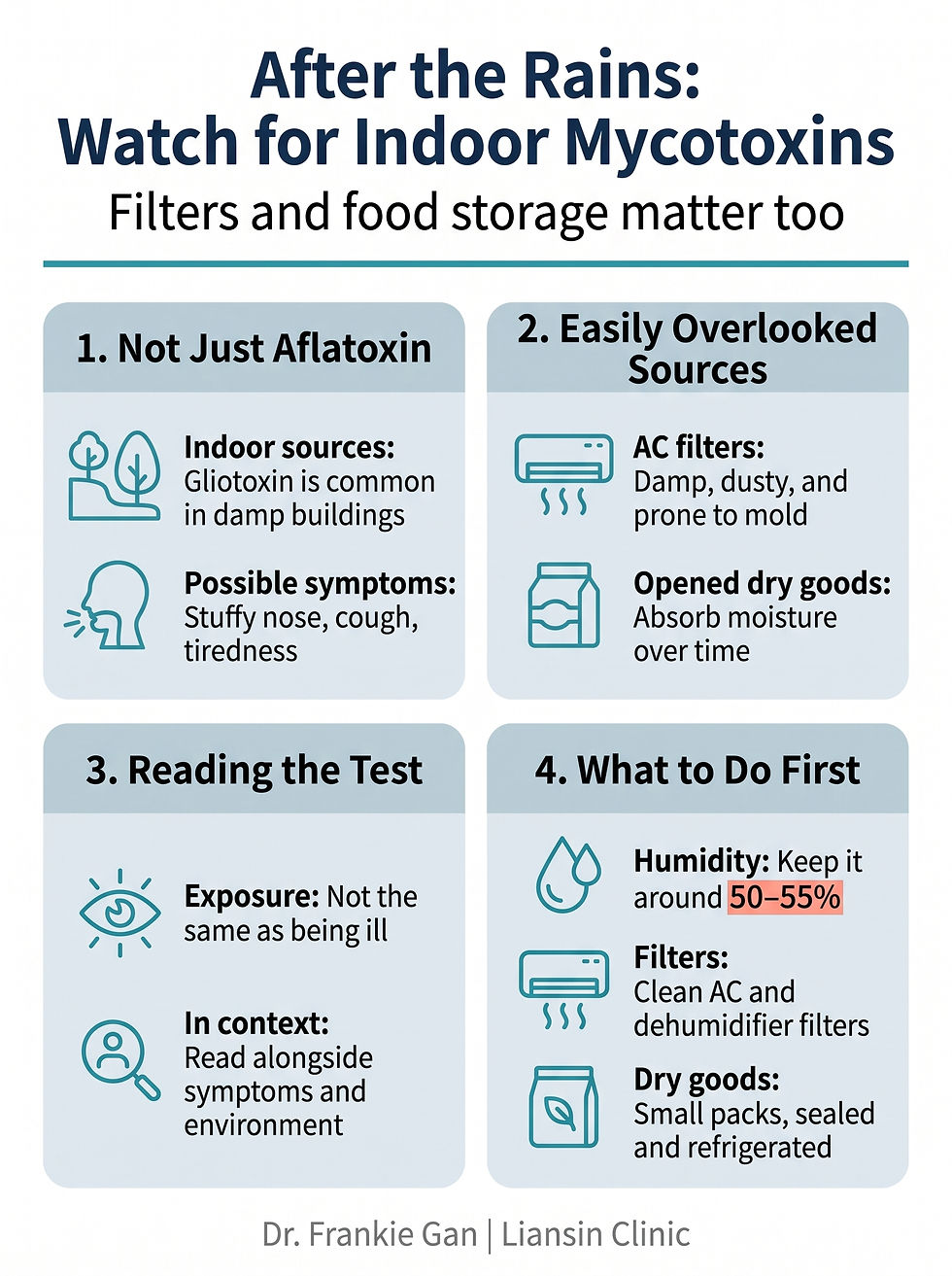
Not just aflatoxin: Gliotoxin and mycophenolic acid can come from damp or water-damaged indoor environments.
Dehumidifying is not enough: Air-conditioner, dehumidifier, and air-purifier filters can grow mold themselves.
Read the test in context: A high result signals exposure and should be interpreted alongside symptoms and the environment, with reducing exposure as the first step.
For most people, a drier, well-maintained home is the most useful place to start.
References
Mendell MJ, Mirer AG, Cheung K, Tong M, Douwes J. Respiratory and allergic health effects of dampness, mold, and dampness-related agents: a review of the epidemiologic evidence. Environ Health Perspect. 2011;119(6):748-756. doi:10.1289/ehp.1002410
Cramer B, Visintin L, Maris E, et al. Human biomonitoring of mycotoxins: key challenges and future directions. Mycotoxin Res. 2025;42(1):13. doi:10.1007/s12550-025-00612-2


Comments